Raj Nair
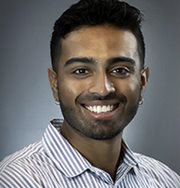
Raj is a fourth-year medical student at Eastern Virginia Medical School (EVMS) in Norfolk and an MRSP Scholar at the NIH, where he works in Dr. Michael Ward’s lab at the National Institute of Neurological Disorders and Stroke. He plans to pursue a career as a physician-scientist focused on neurological diseases. Originally from Kerala, India, and raised in the United States, Raj earned his bachelor’s degree in Neuroscience from the College of William & Mary. He later conducted research in cardiac electrophysiology at Children’s National Hospital and respiratory physiology at the Janelia Research Campus of the Howard Hughes Medical Institute. In medical school, he joined Dr. Nagre Nagaraja’s lab to study novel synthetic endocannabinoids as potential therapies for ventilator-associated pneumonia and acute lung injury.
At EVMS, Raj also volunteered at the student-run free clinic, working with the local Hispanic community. These experiences deepened his understanding of health disparities within the Hispanic population and inspired his commitment to global health. To strengthen communication, he studied Spanish through coursework and one-on-one tutoring with a mentor in Guatemala, hoping to one day employ his skills in South America.
As a Benjamin H. Kean Fellow, Raj will work with Dr. Manuela Verastegui at the Universidad Peruana Cayetano Heredia in Lima, Peru, to investigate how the Taenia solium parasite in neurocysticercosis causes neuronal dysfunction, while exploring the potential role of endocannabinoids in treating NCC and Chagas disease. Outside of medicine, he enjoys film photography, dancing, cooking and hiking.

Characterizing the Impact of Brain Inflammation on Hippocampal Neurogenesis in a Rat Model of Neurocysticercosis
Universidad Peruana Cayetano Heredia
Peru
What does the Kean Fellowship mean to you?
I am deeply grateful to ASTMH for continuing the Ben Kean Fellowship and honored to have been selected as a Fellow, especially during a time when opportunities for global health work are limited. As an aspiring neurologist interested in neuroinfectious diseases, the fellowship has allowed me to pursue neurocysticercosis research in an endemic region well before residency.
Equally important, it has connected me with pioneering researchers in tropical medicine whose mentorship has left a lasting impact on my career trajectory. I hope to continue collaborating with my Peruvian mentor while completing medical school, with the goal of returning to Peru in either a clinical or research capacity. My time there has strengthened my confidence in adapting to new environments and conducting meaningful research in resource-limited settings.
The Ben Kean Fellowship has shown me the unique value of working in endemic regions, not only to advance science, but to better understand the strengths of local communities and the challenges they face.
What do you anticipate learning?
I have been fortunate to conduct research in the United States within well-funded institutions that provide strong infrastructure, financial support and advanced technologies. However, I realized I lacked experience in conducting research in resource-limited regions.
At the Universidad Peruana Cayetano Heredia, I observed the creativity and ingenuity of researchers who minimized waste while maintaining efficient, high-quality methodologies. As I assisted with the immunohistochemistry workflow, I contributed to generate reliable data and suggest new approaches to conserve resources. These experiences taught me how to be resourceful, efficient and adaptable, skills I will carry into future projects in the U.S. and abroad.
Beyond research, I learned from daily life in Peru, navigating public transportation, visiting local markets and exploring neighborhoods that reflect diverse socioeconomic realities. I witnessed how financial burdens, geography and living conditions affect access to water, healthcare and other necessities. My Spanish improved through immersion with colleagues and the local community, reinforcing how valuable in-country language learning can be.
These lessons have taught me to always be observant of what is truly affecting people’s quality of life, and the importance of collaborations with my mentors and colleagues in Peru, ensuring I can continue to contribute meaningfully, while in the U.S. and upon my return.
What interests you about tropical medicine and what problems are you interested in solving?
What excites me most about tropical medicine is its ability to unite the principles of biology, medicine and sociology into a single field of study. Parasites, bacteria, viruses and their vectors are not random invaders, but organisms fulfilling evolutionary roles within the framework of human society. I am fascinated by how they have come to interact with us, and how we, in turn, have become part of their life cycles.
Tropical medicine motivates me to study ecology, entomology and environmental biology, while also drawing on the social sciences to address cultural and economic disparities. I want to explore how traditions and living conditions influence the emergence and persistence of tropical diseases, an understanding that requires immersive, in-country training and exposure. These experiences will guide me in tailoring translational research projects and in implementing novel treatments and improved diagnostic tools for affected communities, considering their unique cultural, environmental and geographic contexts.
For me, tropical medicine represents the opportunity to investigate complex diseases in their natural settings while engaging in travel, language learning and cultural exchange. It demands humility and collaboration, and it challenges practitioners to integrate multiple disciplines to create solutions that reflect the realities of daily life in affected communities.