 |
ASTMH mourns the loss of longtime member Nick White, a distinguished clinician and scientist who helped transform the treatment of malaria worldwide. He passed away February 1.
>>Scroll down for a tribute to Prof. White from ASTMH President Terrie Taylor
ASTMH mourns the loss of longtime member Nick White, a distinguished clinician and scientist who helped transform the treatment of malaria worldwide. He passed away February 1.
Click here for a tribute to Prof. White by 2026 ASTMH President Terrie Taylor, DO.
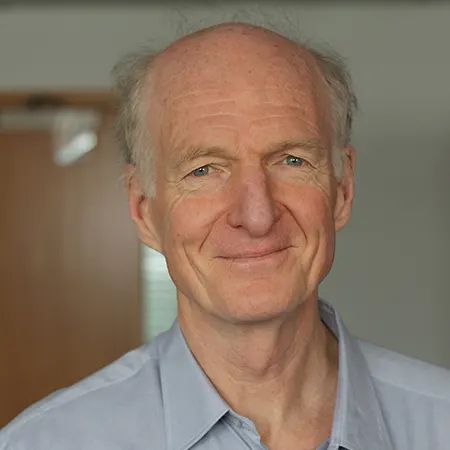
The following information is from St. John's College, Oxford, where Prof. White was a Supernumerary Fellow and Professor of Tropical Medicine (photo courtesy of St. John's):
Prof. White specialized in tropical medicine in developing countries, and his research saved the lives of millions of people living in malaria-endemic countries in Africa and South East Asia. He played a key role in ensuring the global recommendation of artemisinin-based combination therapy (ACT) and intravenous artesunate as the most effective treatment for severe malaria. His scientific interests extended to other infectious diseases of major public health importance, including dengue, melioidosis, typhoid fever, and tetanus.
Since 1980, he was part of a scientific collaboration between the Nuffield Department of Medicine and Mahidol University in Thailand (Mahidol Oxford Research Unit (MORU), becoming its director in 1986. Under his scientific leadership, MORU became world renowned for clinical research that combined methodological rigor with direct relevance to patient care, working in long-term partnership with local hospitals, clinicians, and researchers.
Prof. White was elected as a Fellow of the Royal Society in 2006 and appointed as Knight Commander of the Order of St. Michael and St. George in 2017.
► Read the complete obituary from St. John's here
► Click here to see an obituary from Nuffield Department of Medicine at the University of Oxford
► View an obituary from the Wellcome Trust here
The following tribute was written by 2026 ASTMH President Terrie Taylor, DO.
The malaria parasite is breathing more easily this week, following the unexpected demise of Nick White, an implacable, intransigent, occasionally irascible, often irreverent and highly intelligent foe.
Nick had an enormous impact on malaria morbidity and mortality. He had the capacity to start with a concept, test it in clinical studies, advocate for its impact, and then ensure its inclusion in WHO guidelines. (Right, Prof. White at the bench, with coffee ,in Malawi, circa 1988. Courtesy of Dr. Taylor.)
He was an excellent clinician, and put his training in pharmacology to good use, spearheading the implementation of the artemisinin drugs by designing and leading two heroic randomized clinical trials establishing the superiority of artesunate over quinine in the management of severe malaria in both adults and children. He argued forcefully for the use of rectal artesunate as pre-referral treatment and helped to develop artemisinin combination therapy to slow the development of antimalarial drug resistance.
His impact was indelible on institutions (WHO, The Wellcome Trust) and at his home-away-from-home, the Mahidol Oxford Tropical Medicine Research Unit (MORU) in Bangkok.
Nick’s research interests extended beyond malaria and included melioidosis, typhoid fever, dengue, scrub typhus, and tuberculosis. His curiosity was inexhaustible, and he was energized by obstacles and challenges. Bureaucracies were dealt with briskly, but he had endless patience for working within resource-limited settings.
Nick was a frequent attendee at the ASTMH Annual Meeting, most recently in 2024. He became an ASTMH Distinguished International Fellow in 2005 and delivered the 1994 Vincenzo Marcolongo Lecture on “The Management of Severe and Complicated Malaria.”.
On a personal note, I greatly enjoyed our collaborations over the years. He schooled my late colleague, Malcolm Molyneux, in the clinical management of severe malaria in Bangkok, and then visited us in Malawi as we were establishing our research endeavors there.
We worked on various guideline development groups together, and his knowledge of “the literature” was encyclopedic. The meetings were enlivened by his legendary wit.
Occasionally, his humor emerged in print (appropriately parsed in academic prose), such as the time he bemoaned the epidemic of murine malaria in laboratories around the world (White NJ, et al., Trends Parasitol 2010; 26(1):11-15).
Figure left: Annual numbers of publications describing studies 0n human cerebral malaria (blue) and murine models of cerebral malaria (orange) since 1980 listed on the National Library of Malaria (NLM) PubMed (same ref as above).
We mourn the passing of a giant in the field of malaria. His impact on the field was profound and will be enduring.
Professor Sir Nicholas J. White was a charismatic and inspiring mentor to many and leaves a legacy of well-trained investigators around the world – and so, the respite afforded to the malaria parasite by his passing will be brief. The scientific progeny of Prof Sir Nicholas J. White are well armed, thanks to his life’s work, and will continue to battle this scourge, inspired by his example.
► Read the complete obituary from St. John's here
► Click here to see an obituary from Nuffield Department of Medicine at the University of Oxford
► View an obituary from the Wellcome Trust here
The following tribute was written by 2026 ASTMH President Terrie Taylor, DO.
 |
The malaria parasite is breathing more easily this week, following the unexpected demise of Nick White, an implacable, intransigent, occasionally irascible, often irreverent and highly intelligent foe.
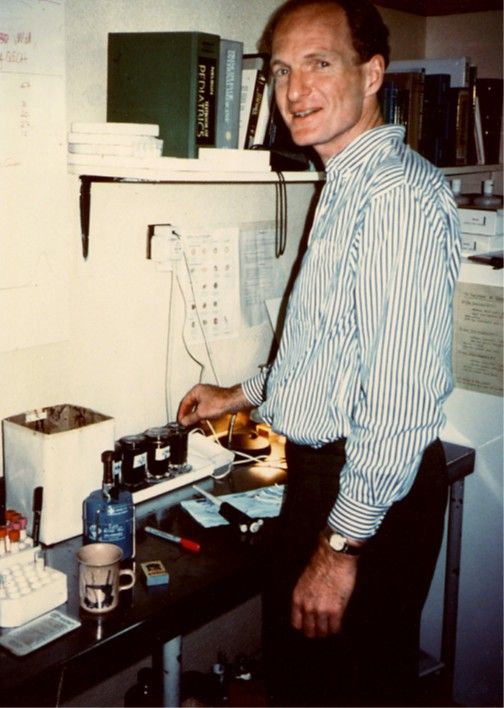
Nick had an enormous impact on malaria morbidity and mortality. He had the capacity to start with a concept, test it in clinical studies, advocate for its impact, and then ensure its inclusion in WHO guidelines. (Right, Prof. White at the bench, with coffee ,in Malawi, circa 1988. Courtesy of Dr. Taylor.)
He was an excellent clinician, and put his training in pharmacology to good use, spearheading the implementation of the artemisinin drugs by designing and leading two heroic randomized clinical trials establishing the superiority of artesunate over quinine in the management of severe malaria in both adults and children. He argued forcefully for the use of rectal artesunate as pre-referral treatment and helped to develop artemisinin combination therapy to slow the development of antimalarial drug resistance.
His impact was indelible on institutions (WHO, The Wellcome Trust) and at his home-away-from-home, the Mahidol Oxford Tropical Medicine Research Unit (MORU) in Bangkok.
Nick’s research interests extended beyond malaria and included melioidosis, typhoid fever, dengue, scrub typhus, and tuberculosis. His curiosity was inexhaustible, and he was energized by obstacles and challenges. Bureaucracies were dealt with briskly, but he had endless patience for working within resource-limited settings.
Nick was a frequent attendee at the ASTMH Annual Meeting, most recently in 2024. He became an ASTMH Distinguished International Fellow in 2005 and delivered the 1994 Vincenzo Marcolongo Lecture on “The Management of Severe and Complicated Malaria.”.
On a personal note, I greatly enjoyed our collaborations over the years. He schooled my late colleague, Malcolm Molyneux, in the clinical management of severe malaria in Bangkok, and then visited us in Malawi as we were establishing our research endeavors there.
We worked on various guideline development groups together, and his knowledge of “the literature” was encyclopedic. The meetings were enlivened by his legendary wit.
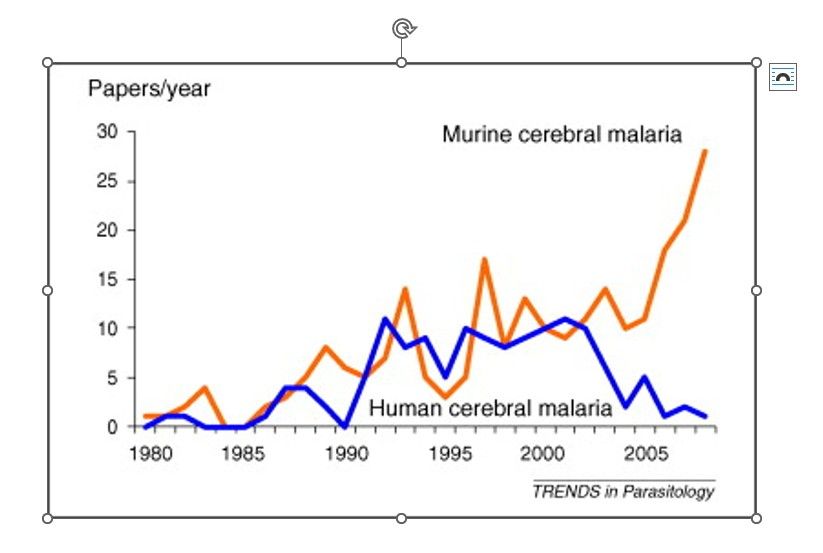 |
Occasionally, his humor emerged in print (appropriately parsed in academic prose), such as the time he bemoaned the epidemic of murine malaria in laboratories around the world (White NJ, et al., Trends Parasitol 2010; 26(1):11-15).
Figure left: Annual numbers of publications describing studies 0n human cerebral malaria (blue) and murine models of cerebral malaria (orange) since 1980 listed on the National Library of Malaria (NLM) PubMed (same ref as above).
We mourn the passing of a giant in the field of malaria. His impact on the field was profound and will be enduring.
Professor Sir Nicholas J. White was a charismatic and inspiring mentor to many and leaves a legacy of well-trained investigators around the world – and so, the respite afforded to the malaria parasite by his passing will be brief. The scientific progeny of Prof Sir Nicholas J. White are well armed, thanks to his life’s work, and will continue to battle this scourge, inspired by his example.